A customer may look completely normal when an account is opened. Their documents may be valid, and the information they provide may match what appears in the application. The problem can appear later when the same name is found on a sanctions list or when a company is linked to a restricted person. This is where sanctions screening becomes an important part of financial crime compliance.
A proper screening process helps businesses check whether customers, companies, beneficial owners, and other connected persons appear on official sanctions lists. It can prevent restricted parties from accessing financial services or moving money through the financial system when sanctions rules prohibit such activity. At the same time, screening cannot depend on names alone because two unrelated people can easily share the same or a very similar name.
What Is Sanctions Screening?
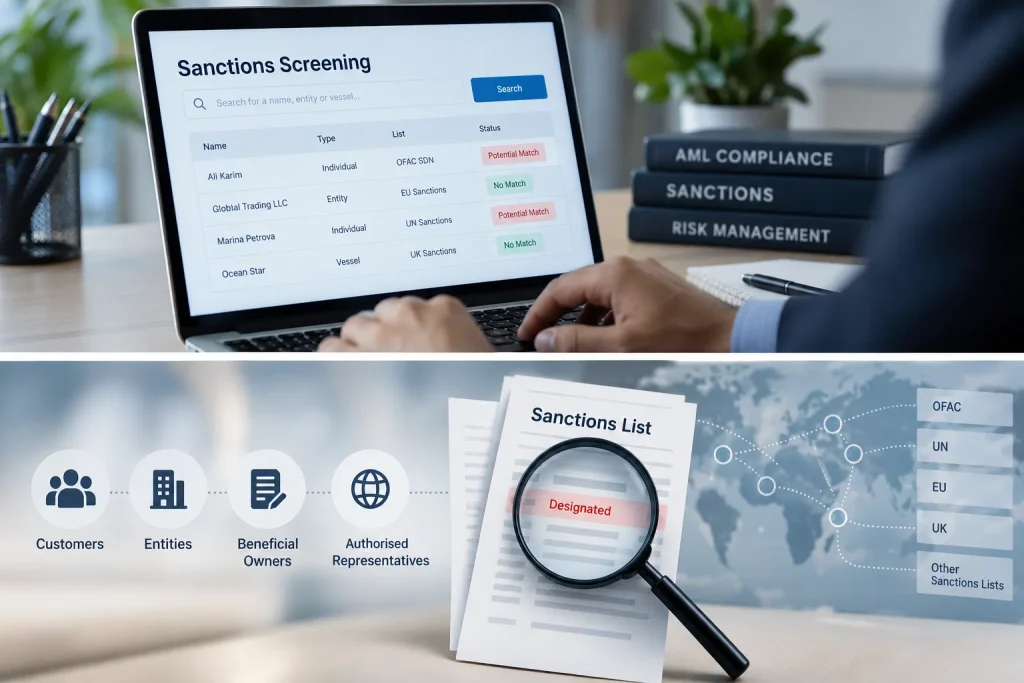
Sanctions screening is the process of comparing information about a person or organisation with official sanctions records. Financial institutions and other regulated businesses normally perform these checks when a customer joins and may continue checking during the customer relationship because sanctions information can change after an account has already been opened.
The person being screened is not always just the customer whose name appears on the application. Depending on the applicable rules and the type of relationship, screening may also cover beneficial owners, authorised representatives, companies, and people acting on behalf of a customer. SECP guidance in Pakistan, for example, explains that customers, beneficial owners, and persons acting on behalf of customers should be checked against applicable sanctions requirements.
A name appearing similar to a sanctioned person does not automatically mean the customer is that person. Imagine that an alert appears for someone called Mohammad Khan. That name alone gives an analyst very little certainty because many unrelated people may share it.
The analyst would normally look at other available information such as the person’s date of birth and nationality. An address or another reliable identifier can also help determine whether the record refers to the same person. This review matters because blocking a legitimate customer because of a similar name creates a different compliance and customer service problem.
Why Is Sanctions Screening Important for AML Compliance?
Sanctions screening gives compliance teams a way to identify relationships that may expose a business to sanctions restrictions or financial crime risks. A company may otherwise start dealing with a customer without realising that the person, organisation, or connected party has been designated under an applicable sanctions regime.
The requirements also connect with broader international efforts against terrorist financing. FATF Recommendation 6 deals with targeted financial sanctions related to terrorism and terrorist financing. In June 2026, FATF revised the recommendation so that relevant sanctions measures remain consistent with humanitarian exemptions provided under applicable United Nations Security Council resolutions.
For an AML team, the practical challenge is not simply finding as many matches as possible. A screening system that produces large numbers of weak alerts can leave analysts spending hours checking unrelated people, while a system that misses genuine matches creates a much more serious compliance risk. Good screening therefore depends on the quality of the information being compared and the way potential matches are reviewed.
False positives are part of this problem. A legitimate customer may be delayed because their name resembles a sanctioned person’s name even though their date of birth or nationality clearly differs. Better matching and better customer data help the reviewer reach that conclusion faster instead of treating every similar name as the same level of risk.
Where Can I Find the OFAC Sanctions List?
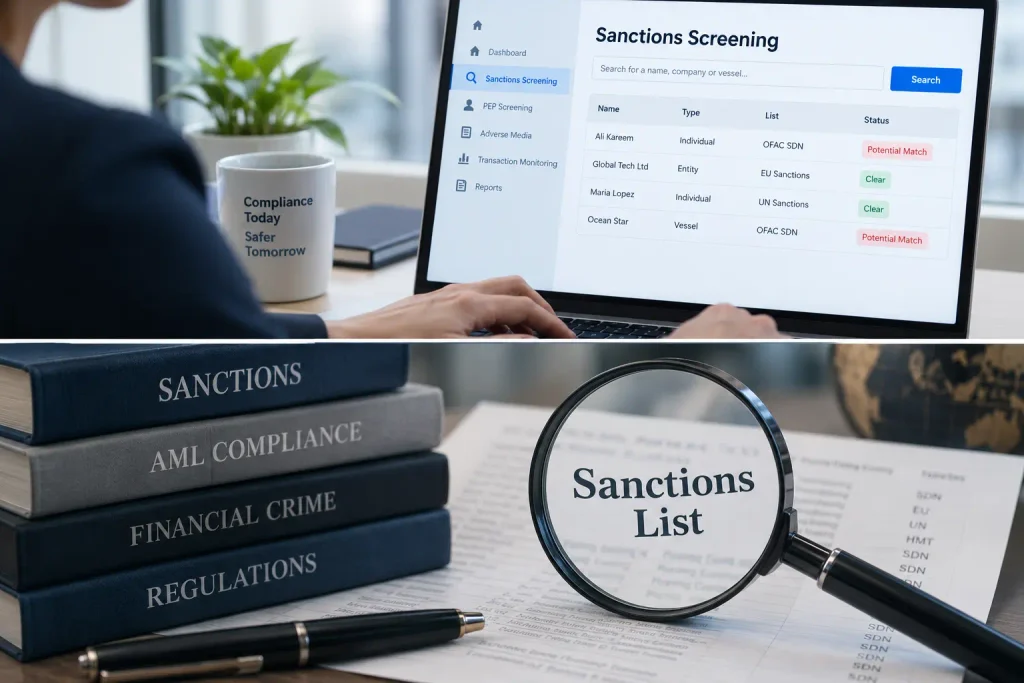
The OFAC sanctions list refers to sanctions information maintained by the United States Department of the Treasury’s Office of Foreign Assets Control. One of its best known resources is the Specially Designated Nationals and Blocked Persons List, commonly known as the SDN List.
The SDN List can contain designated individuals and organisations along with other sanctioned parties such as vessels or aircraft. OFAC also maintains several lists outside the SDN List for restrictions that operate under different sanctions programmes. Businesses therefore need to understand which lists apply to the activity they are screening rather than assuming that checking one list covers every possible restriction.
These records also change. In July 2026, OFAC removed 84 individuals and entities from the SDN List and updated identifying information for 22 entries. A business using a saved copy of the list from several months earlier could therefore be working with information that no longer reflects the current status of those records.
This is why list updates are a practical part of the screening process rather than an administrative detail. New parties can be added while existing records can be changed or removed. The screening system needs access to current sanctions information so that a decision is not being made from a list that has already fallen behind official updates.
How Does AML Sanctions Screening Work?
The process usually starts with the information collected during customer onboarding. A business may already have the customer’s full name and date of birth along with information such as nationality, address, company details, or beneficial ownership records. The available information is compared with the sanctions lists that are relevant to the business and its regulatory obligations.
The first result is not always a simple yes or no answer. Screening software may return a possible match because a name looks similar to a sanctions record even when some letters are different. OFAC’s own sanctions search tool, for example, can use approximate matching to account for spelling differences and name variations.
Suppose a new customer named Ahmed Hassan produces a possible match during onboarding. The analyst would not normally decide the case from the name alone. The date of birth, nationality, address, and other available details can then be compared with the information attached to the sanctions record.
If those details show that the records belong to different people, the alert may be cleared as a false positive. When several important identifiers correspond with the sanctions record, the case requires further review and the business can take the action required under the applicable sanctions rules. The important part is that the alert leads to an investigation rather than an automatic assumption.
The same issue exists with organisations. A company name may resemble the name of a sanctioned entity while registration details or ownership information show that they are unrelated. In other situations, the company itself may not appear prominently on a list, but its ownership or connection with a designated party may require closer examination.
Sanctions screening therefore works best as an identification and review process. Software finds records that deserve attention, while the information available about the customer helps the compliance team work out whether there is a genuine connection.
Customer information collected during KYC verification can also provide the identifiers needed to review possible sanctions matches more accurately.
Making Sanctions Screening More Accurate and Practical
Access to updated sanctions lists is only one part of an effective screening process. The system also needs enough useful customer information to separate a real match from a person who happens to have a similar name. Without that context, compliance teams can receive alerts that are technically possible but not particularly useful.
Matching also becomes harder when names appear in different forms. A person’s name may be translated from another language, written in a different order, or recorded with a spelling variation. Screening technology needs to account for these differences because an exact character for character search can miss records that refer to the same person.
AML Watcher states that it uses data from more than 215 sanctions regimes and refreshes its sanctions data every 15 minutes. Its matching technology also considers name variations and different languages together with additional identifiers. That approach gives analysts more information when they need to decide whether an alert deserves further investigation.
This becomes especially useful when a compliance team handles a large number of customers. Analysts should not need to spend the same amount of time on every loosely similar name because weak alerts can consume resources that should be focused on stronger matches. Better matching helps narrow the workload while still allowing suspicious records to receive proper attention.
Businesses comparing sanctions screening software should therefore look beyond the number of lists a provider claims to cover. Data freshness matters because sanctions records change, while matching quality matters because the system still needs to recognise relevant name variations without producing unnecessary alerts every time two names look alike.
AML Watcher also combines sanctions screening with PEP screening, adverse media checks, and transaction monitoring within the same AML workflow. Keeping these checks connected can give compliance teams more context when a customer requires further review instead of examining each risk indicator in isolation.
Sanctions screening is ultimately not a one-time name search performed during account opening. Customers and organisations can change while sanctions lists also continue to change. A useful screening process keeps those changes visible and gives analysts enough information to decide whether a potential match represents a real compliance concern or simply another person with a similar name.
Businesses that want to review how these checks can work within a broader AML process can explore AML Watcher and its sanctions screening tools. The important question is not only whether the software can return a match. It is whether the information behind that match helps the compliance team make a reliable decision without creating unnecessary work for every similar record.


