During a video call, something can feel slightly off even when the person on screen looks convincing. The difficult part for a security system is judging those signals while the conversation is still happening, rather than examining the recording carefully afterwards. Deepfake detection software is built for this kind of analysis by looking for signs that the face, voice, or video may have been manipulated.
Artificial intelligence has made synthetic media far more convincing than it once was. The same technology can be useful for entertainment and creative work, but it can also be used to imitate another person or alter what appears to happen in a recording. For security teams, the difficult part is not simply finding a fake after the event. The harder task is deciding whether something looks suspicious while the interaction is still happening.
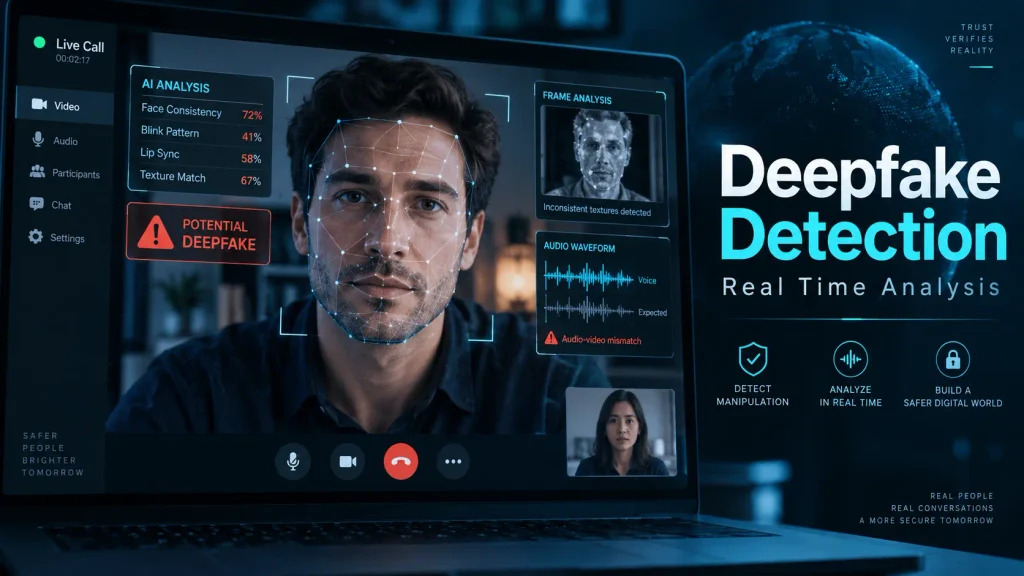
What Is Deepfake Detection Software?
Deepfake detection software examines digital media for patterns that may be associated with artificial generation or manipulation. Depending on the system, it may look at facial movement, lighting, image texture, speech characteristics, or the relationship between what can be seen and heard. No single signal has to prove that a video is fake. Several weak signals can instead contribute to a broader assessment of whether the media appears genuine or requires closer checking.
The same type of analysis can be applied in more than one setting. A recorded file gives the system time to inspect material after it has been captured, while a live stream or video call arrives continuously and needs to be assessed as it appears. That difference matters because a method that works well on an uploaded recording may be too slow for a live identity check.
Why Real Time Detection Is More Difficult
A recorded video gives a detection system more freedom because the full file is already available. It can inspect individual frames, compare different moments in the recording, and spend more computing resources on sections that look unusual. A live interaction does not offer the same amount of time because new video and audio continue to arrive while the analysis is taking place.
This creates a practical tradeoff between how much the system can inspect and how quickly it can respond. A detailed check may identify more subtle manipulation, but a long delay can make a live verification process frustrating or unusable. A faster result is more useful during the call, although the system has less time to examine complex signals before the next part of the interaction arrives.
How Real Time Deepfake Detection Works
During a live interaction, the detector does not need to wait until the entire call has ended. It can examine incoming visual and audio information as it arrives and compare different signals over time. The exact method varies between systems, but the useful part of real time analysis is that suspicious behaviour can be noticed while there is still an opportunity to request another check or change the verification flow.
Facial Analysis
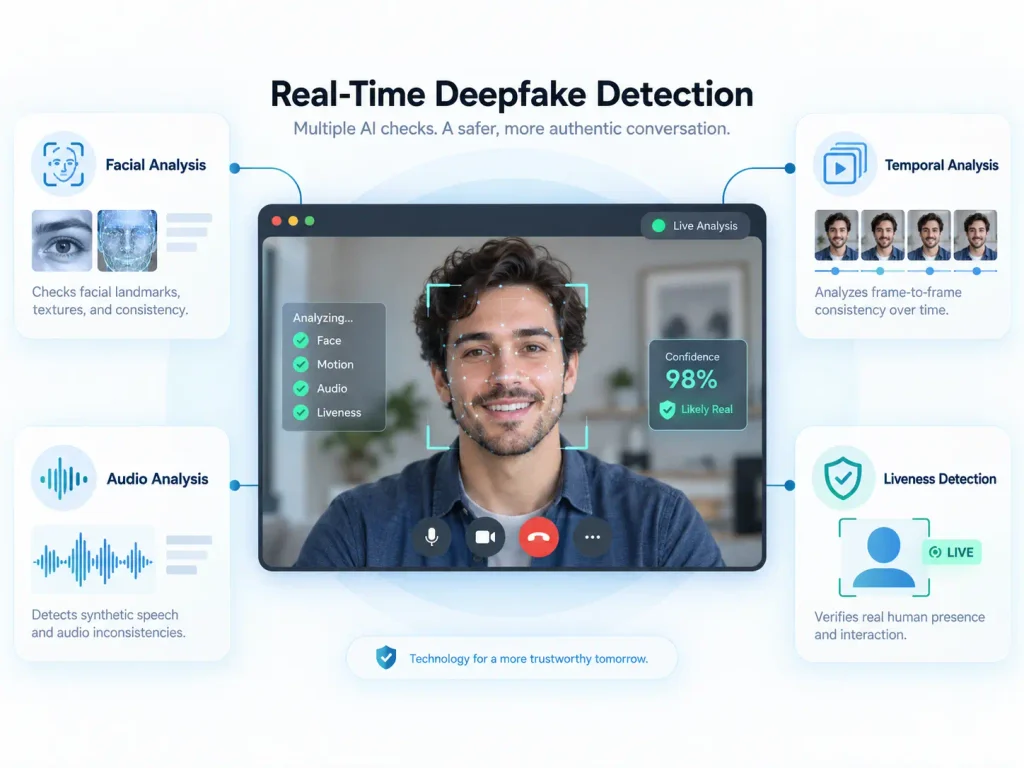
A face may look convincing in a single still image but behave less naturally across a moving sequence. Detection models can therefore examine details such as facial texture, edge consistency, expressions, and how facial movement fits with the rest of the frame. When the face turns or the expression changes, small inconsistencies may become easier to notice than they were in one isolated frame.
This does not mean that every unusual facial detail is evidence of a deepfake. Poor lighting, camera processing, or video compression can also change the appearance of a genuine face. The detector needs to consider those normal causes because otherwise ordinary video problems could create unnecessary suspicion.
Temporal Analysis
A manipulated video can sometimes look realistic frame by frame while showing small inconsistencies from one moment to the next. Temporal analysis looks at how visual information changes across a sequence rather than treating every frame as a separate image. Irregular motion, unstable facial details, or sudden visual changes may add useful context when the system is deciding whether the sequence needs closer attention.
This type of analysis is especially relevant during a live call because the detector is constantly receiving new information. A signal that looks weak in one frame may become more meaningful when the same kind of inconsistency appears again as the person moves.
Audio Analysis
Deepfakes are not limited to faces. A voice can also be generated or modified, so some detection systems inspect speech characteristics and other audio patterns for signs that something may have been altered. During a video interaction, the system may also compare the visible movement of the mouth with the speech being heard.
A mismatch by itself should not be treated as proof of manipulation because network delay or poor video synchronisation can produce similar behaviour. It becomes more useful when it appears together with other suspicious signals, which is why audio analysis is generally more informative as part of a wider assessment.
The Role of Liveness Detection
Deepfake detection and liveness detection are related, but they answer different questions. Liveness detection tries to determine whether a real person is physically present during the interaction and can help identify attempts that use a photograph or a replayed video. Deepfake detection looks more closely at whether the digital media itself may have been artificially generated or altered.
The difference becomes clearer during remote identity verification. Facial recognition can compare a face with an enrolled identity, while liveness detection can check for evidence of a physically present person. Deepfake analysis adds another layer by examining whether the video being presented shows signs of digital manipulation, which reduces the need to depend on one type of check alone.
Many of the techniques used by modern AI face swap and lip sync tools can make altered faces and speech look more convincing, which also makes obvious signs of manipulation harder to notice.
Challenges Created by Generative AI
The material that detection systems are trying to identify does not stay the same for long. Generative AI tools continue to improve, and newer manipulation methods may not leave exactly the same visual or audio clues that older methods produced. A detector that performs well against familiar examples can therefore face a much harder task when it encounters a technique it has not seen before.
Ongoing testing matters for this reason. Detection models need exposure to varied synthetic media and realistic recording conditions because a narrow test set can make performance look stronger than it will be in everyday use. Regular evaluation helps reveal where the system is becoming less reliable as generation methods change.
Video Quality and Environmental Factors
A live verification session rarely happens under perfect studio conditions. Someone may be using an older camera, sitting in weak light, or connected through an unstable internet connection, and each of those conditions can reduce the amount of useful detail in the video. Compression can remove fine facial information, while background noise can make audio analysis less reliable.
These problems matter because genuine technical limitations can sometimes resemble manipulation. A blurry face should not automatically become a deepfake warning simply because important visual details are missing. A useful detection process therefore has to separate ordinary recording problems from patterns that remain suspicious after those conditions are considered.
Managing False Positives
No deepfake detector should be treated as a final judge of whether a person or video is genuine. Real video can contain strange edges, delayed audio, or unusual facial movement for completely ordinary reasons. If every unusual signal causes an immediate rejection, genuine users can be forced through repeated checks even when they have done nothing wrong.
A more practical approach is to use the detection result as one part of a wider verification process. When the confidence level becomes suspicious, the service can request another form of verification instead of making the entire decision from one automated result. This gives the system a way to respond to risk without treating every uncertain signal as confirmed fraud.
Where Real Time Detection Can Be Useful
Real time analysis is most valuable when a live interaction carries enough risk that waiting until later would be too late. The exact level of checking can change depending on what the person is trying to do, because a casual meeting does not carry the same consequences as identity verification or access to a sensitive account. Common situations include:
- Remote identity verification and digital onboarding
- Video customer support where identity needs to be confirmed
- Financial communication or access to sensitive services
- Remote interviews and other live interactions where impersonation matters
The purpose is not to place the strongest possible detection on every video call. Extra checks can create delay and inconvenience, so they make more sense when the cost of impersonation or manipulated media is high enough to justify that friction. This keeps the security process connected to the actual risk of the interaction.
Building a Layered Security Approach
Deepfake detection becomes more useful when it works beside other forms of verification instead of replacing them. Facial recognition can help determine whether a face resembles the expected identity, while liveness detection can look for evidence that a real person is present. Document checks or device information can provide another source of context when the media itself does not give a clear answer.
The reason for using several signals is simple. Every individual method has situations where it can be uncertain or wrong, especially when video quality is poor or an attack uses a new technique. When different checks point in the same direction, the service has more context for deciding whether the interaction can continue normally or needs further verification.
Privacy and Data Protection Considerations
Real time detection may involve sensitive video, voice, and biometric information, so the way that information is handled matters as much as the detection process itself. An organisation needs to know what data is being collected, whether any part of it is stored, and who can access it after the interaction. Retention periods and security controls also matter because keeping sensitive media longer than necessary can create an additional privacy risk.
Applicable privacy requirements will depend on the location and use case, so the handling policy needs to match the environment in which the system is deployed. Stronger fraud detection does not remove the responsibility to protect the people whose faces and voices are being analysed.
The Future of Real Time Deepfake Detection
Deepfake detection is likely to rely on a wider range of signals as synthetic media becomes harder to identify from one obvious flaw. Future systems may compare visual behaviour with audio information and other contextual evidence to build a more complete view of the interaction. The useful result may therefore be less about producing a simple label and more about estimating how confident the system is that the media can be trusted.
This approach also fits naturally with digital identity systems. Deepfake analysis can work beside facial verification and liveness checks, with each part answering a different security question. As live digital interactions become more common, the quality of that combined assessment will matter more than searching for one universal clue that proves whether every video is real or fake.
FAQs
What is deepfake detection software?
Deepfake detection software analyses digital media for signs that a face, voice, or other part of the content may have been artificially generated or manipulated. The result is usually more useful as a risk signal than as absolute proof on its own.
Why is real-time deepfake detection difficult?
A live system has to inspect incoming video and audio without creating a delay that makes the interaction unusable. Camera quality, network problems, and changing manipulation methods can also make suspicious signals harder to separate from ordinary technical issues.
Can deepfake detection work during video calls?
Some systems can analyse video and audio while a call is taking place. Their performance can still vary with the quality of the media and the type of manipulation, so a suspicious result may need another verification step before a final decision is made.
Is deepfake detection the same as liveness detection?
No. Liveness detection focuses on whether a real person appears to be physically present, while deepfake detection looks for signs that the digital media may have been generated or altered. They can be used together because each one addresses a different part of the verification problem.
Can deepfake detection identify fake voices?
Some detection systems can inspect speech for patterns associated with generated or modified audio. Voice analysis becomes more useful when it is considered together with the visible video and other verification signals rather than being treated as a standalone answer.
Is deepfake detection 100% accurate?
No detection method can be treated as perfect, especially while generation techniques continue to change. Genuine media can also contain artefacts caused by cameras, compression, or network conditions, which is why uncertain results are better handled through additional verification.
Conclusion
Aby real time deepfake detection is difficult because the system has to make sense of changing video and audio while the interaction is still happening. It must work quickly enough to be useful without confusing ordinary camera problems or connection issues with evidence of manipulation. That balance is what makes live detection more demanding than checking a recording later.
Deepfake detection can still add meaningful protection when it is used with other verification methods and when uncertain results lead to sensible additional checks. The goal is not to pretend that one detector can label every piece of media perfectly. A stronger approach is to collect enough reliable context to decide whether a live interaction looks normal or deserves closer verification.


